Background
People engage with music in a wide variety of ways, from listening and sharing to discovering new sounds and connecting with artists. But current tools don’t quite support spontaneous sharing, finding niche music, new genres, or building deeper connections through sound.
Role
UX Research Lead
Prototyping Lead
Team
1 project manager &
4 designers
Building connections between artist & listener
A design entirely focused on understanding the artist
Users want participation, not just personalization. Research showed that while listeners appreciated recommendations and discovery tools, they were more excited by features that let them participate — commenting on lyrics, seeing what friends are listening to, and engaging with artist posts. Passive personalization wasn't enough.
Artist context is an underserved need. A major gap identified through competitive analysis was that no major platform gives artists a dedicated space to explain their work. The lyric annotation feature (where artists can annotate specific lines and respond to listener comments) directly addressed this and became one of the signature differentiators of Chords.Direction is the hardest design problem. The team's biggest challenge was scoping — music platforms are already heavily optimized, making it hard to find a meaningful gap. The breakthrough came when they shifted their lens from listener-first to artist-first, which unlocked the unique angle the whole product was built around. This is a reminder that the right POV matters as much as the execution.
Bridge the gap between artists and listeners. The core goal was to move beyond passive streaming and create a platform where listeners could engage more deeply with artists — understanding their creative process, reading lyric annotations, and accessing exclusive content. Existing platforms like Spotify and Apple Music were optimized for discovery and playback, but largely ignored the artist-to-fan relationship.
SYMPATHIZE
Research
Through a combination of surveys and qualitative interviews, the team found that users were deeply engaged with music on a daily basis — most listening for over an hour a day — yet their experience on current platforms remained largely passive. While social features were appreciated, users expressed a stronger interest in deeper, more meaningful forms of engagement: understanding the story behind the music, connecting with others through shared listening, and feeling closer to the artists they loved. Competitive analysis of platforms like Spotify, Apple Music, Weverse, and Genius further confirmed that while discovery and personalization were well-covered, no platform was meaningfully bridging the gap between artists and their listeners. The biggest gap wasn't in the music itself — it was in the context, community, and connection surrounding it.
User Persona
INSERT PHOTO
INSERT PHOTO
After collecting research data, the team synthesized their findings into an affinity map organized around four main themes: social, listening, artist focus, and user focus. This process helped surface patterns across survey responses and interview insights, grouping ideas around how users currently engage with music, what they wish they could do socially within a platform, and what kind of artist-related content they craved. From this mapping, a few feature directions emerged as clear priorities — including a forum space for music discussion, a dedicated area for artists to share their music-making process, and a place for lyric content. The affinity map ultimately served as the bridge between raw research and concrete design decisions, narrowing the team's focus toward features that balanced both the listener's and artist's needs.
THE PROBLEM
"How might we create a more interactive and social listening experience that helps users feel connected to their music, favorite artists, and fellow fans?"
Through mixed-methods research, we found that while users spent over an hour a day listening to music, their relationship with it remained largely passive — and existing platforms offered little beyond personalized playback. This surfaced three key opportunities: giving listeners something to do beyond streaming, enabling social connection through shared listening, and closing the gap between artists and fans. No major platform gave artists a dedicated space to share their creative process, which became the sharpest insight driving our design. Features like lyric annotations, song portfolios, and friend activity feeds were built in direct response, shaping Chords into a platform that transforms listening from a solitary habit into a community-driven experience centered on the artist.
IDEATION
Sketching
INSERT PHOTO
After synthesizing research findings, the team moved into sketching and low-fidelity wireframes to begin visualizing the structure of the platform. This stage was focused on exploring layout ideas and mapping out how users would navigate the experience from screen to screen. Through sketching, the team was able to rough out the core pages of the platform — the home, search, feed, profile, and library — establishing a foundational framework before committing to any visual direction. Alongside the sketches, the team developed a user flow to define the overall navigation logic, outlining how a user would move through onboarding into the homepage, and across each of the five main sections. This stage was less about aesthetics and more about structure — ensuring the platform's architecture made sense before moving into higher-fidelity iterations.
Feature Matrix
INSERT PHOTO
After the affinity mapping session, the team took all of the features they had ideated and plotted them on a feature matrix to evaluate and prioritize what to move forward with. The matrix was used as a decision-making tool, weighing each feature against its importance and feasibility to determine which ideas were worth pursuing and which to set aside. This process helped the team cut through the volume of ideas generated during ideation and align on a focused set of features that would deliver the most value to users. Rather than trying to build everything, the matrix pushed the team toward intentional design decisions — keeping features that directly addressed the core research findings around social connection, artist engagement, and interactive listening, while deprioritizing ideas that were either too complex or too peripheral to the platform's core purpose.
PROTOTYPE
User Flow
INSERT PHOTO
Once the team had settled on their core features, they mapped out a complete user flow to define how a user would navigate through the platform from start to finish. After onboarding, users land on the homepage, where they are greeted with artist stories at the top and self-tailored music recommendations below, with a direct path into messaging. From there, users can navigate across five main sections. The search page allows users to look up artists, songs, and lyrics, while also surfacing recent searches, artist lives, and trending lyrics. The feed serves as a social hub, displaying artist updates and friends' listening activity, with the ability to like or save songs directly to the library. The library organizes a user's saved playlists and songs, and houses one of the platform's most distinctive features — lyric annotations, where tapping a highlighted line reveals artist-created posts and listener comments. Finally, the profile page offers two distinct views: a listener profile and an artist profile, the latter showcasing announcements and a full song portfolio. The user flow was a critical step in ensuring that each feature had a logical home within the platform and that the overall navigation felt cohesive and intuitive.
Mid-Fidelity
INSERT PHOTO
With the low-fidelity sketches and user flow in place, the team transitioned into mid-fidelity wireframes to begin refining the structure and layout of the platform in greater detail. This stage involved multiple iterations on layout design, with the goal of determining what was both visually appealing and easy for users to navigate. The team used this phase to better define and flesh out the platform's core features, particularly those that captured the social and artist-connection aspects central to Chords' identity. Key features that were developed and refined during this stage included song portfolios, which provided contextual information and media tied to each track, artist lyric annotations that allowed creators to explain specific lines and engage with listener comments, artist stories and lives for real-time and ephemeral content, friend activity status for social discovery, and listening analytics to give users a reflective overview of their habits. The mid-fidelity wireframes also gave the team enough of a tangible prototype to move into usability testing, where they could gather real user feedback before committing to a final visual direction. This stage was ultimately the bridge between rough structure and a fully realized design system.
Branding
INSERT PHOTO
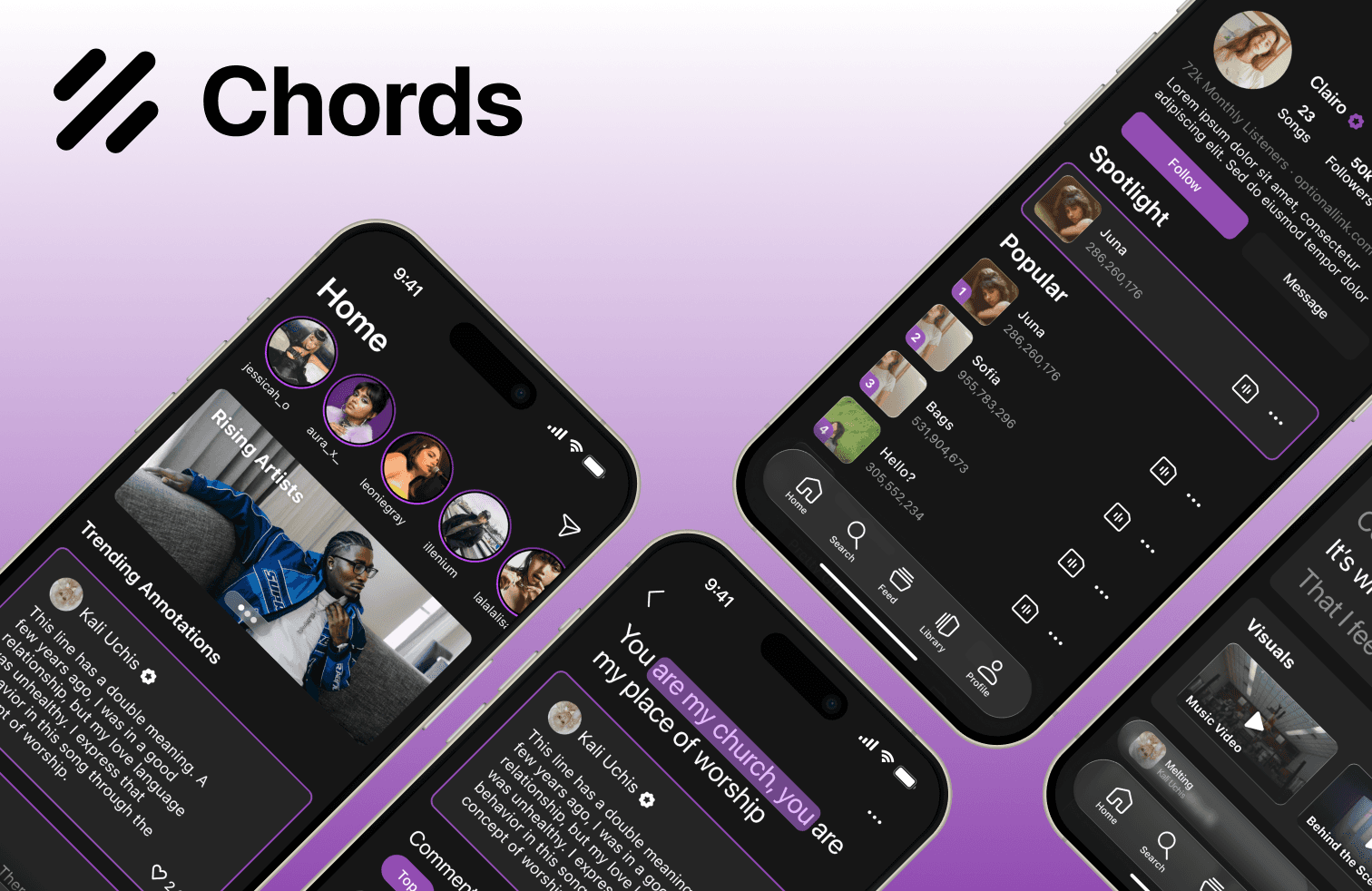
With the platform's structure and features validated through usability testing, the team turned their attention to finalizing the visual identity of Chords. The design system was built around a modern and intuitive aesthetic, drawing inspiration from Apple's latest software design language. This influenced the decision to incorporate Liquid Glass components and rounded corners throughout the interface, giving the platform a clean, contemporary feel. For the color palette, the team leaned into deep, dark tones — primarily black and purple — chosen intentionally to evoke a sense of intimacy and immersion, reinforcing the idea of Chords as a safe space where users could form a deeper emotional connection with music and artists. Typography was set in SF Pro, selected for its consistency and legibility across the interface. Iconography and components were kept simple and restrained, staying true to the color palette without adding unnecessary visual noise. Every branding decision was made in service of the platform's core emotional goal — creating an experience that felt personal, immersive, and deeply connected to the world of music.
TEST
User Testing
INSERT PHOTO of changes
With the mid-fidelity wireframes completed, the team moved into usability testing to gather real feedback before finalizing the design. Participants were given a set of five structured tasks to complete within the prototype: finding an artist story on the homepage, searching for an artist and locating their live, navigating to the library to find a lyric annotation, finding the activity status within the feed, and locating an artist's portfolio page through their profile. These tasks were designed to test the discoverability and intuitiveness of Chords' most distinctive features, ensuring that users could find and understand them without guidance. After synthesizing the feedback from this first round of testing, the team identified areas of friction and made significant iterative changes to the overall design. This included revisiting the design system entirely and transitioning to a new visual approach that better aligned with user preferences — ultimately leading to the adoption of the Apple-inspired Liquid Glass aesthetic. Usability testing proved to be a pivotal turning point in the project, not just validating what was working but surfacing the visual and navigational gaps that shaped the final direction of the product.
FINAL PROTOTYPE
INTRODUCING: CHORDS !
INSERT GIFS of Prototype
With research, iteration, and usability testing informing every decision, the team arrived at the final prototype for Chords — a fully realized music platform designed to deepen the connection between listeners and artists. The final design was brought to life across five core sections. The home and search pages serve as the entry point into the platform, helping users discover artists, new releases, and personalized recommendations, while also providing access to stories, messaging, and trending content. The feed and activity section functions as the social heartbeat of the app, displaying posts and exclusive content from followed artists organized by category, alongside a friends activity feature that lets users see what others are listening to in real time. The library goes beyond simple playlist organization — users can tap into highlighted lyrics to read artist annotations and leave comments, making it one of the most interactive and distinctive features of the platform. The profile offers two distinct experiences: a listener profile with listening habits and insights, and an artist profile complete with an about section, follower engagement, and detailed song portfolios that give fans a deeper look into the music they love. Visually, the final prototype came together with a dark, purple-toned palette, Liquid Glass components, SF Pro typography, and a clean icon system — creating an immersive and cohesive experience that felt true to Chords' core mission of transforming music listening from a solitary habit into a deeply connected, community-driven experience.
REFLECTION
Presentation
INSERT PHOTOS
On presentation day, the team delivered a ten-minute pitch covering their entire design process — from initial research and affinity mapping all the way through to the final prototype. The presentation was made to a judge named Jamie, who provided valuable feedback following the team's pitch. Much of Jamie's critique centered on visual details within the design, particularly around the layout and navigation bar components. Rather than viewing this as a setback, the team took the feedback constructively, using it to identify specific areas for refinement in future iterations. The presentation marked the culmination of six weeks of work and served as both a moment of reflection on how far the project had come and a jumping-off point for what comes next.
Key Takeaways
Chords was as much a lesson in process as it was in design. The team's biggest challenge — and ultimately their biggest breakthrough — was finding a meaningful direction in a market already saturated with highly optimized platforms. The turning point came when the team shifted their perspective from the listener to the artist, uncovering a gap that no major platform had meaningfully addressed. This reinforced the value of thorough research and competitive analysis, not just to validate assumptions but to reveal the angles that others had overlooked. The project also highlighted the importance of iteration — from low-fidelity sketches to mid-fidelity wireframes to usability testing, each stage surfaced new insights that meaningfully shaped the final product, including a complete overhaul of the visual design direction following user feedback. Working within a six-week sprint pushed the team to make deliberate, focused decisions at every stage, using tools like the feature matrix and affinity map to stay grounded in research rather than chasing ideas. Most broadly, Chords reinforced that the best design solutions don't just solve a functional problem — they tap into something emotional, turning an everyday habit like listening to music into an experience that feels personal, communal, and deeply human.
Next Steps
Following the presentation, the team outlined a clear vision for where Chords would go next. On the product side, the focus would be on adding more micro-interactions and enhancing existing features to increase overall user engagement, improving the recommendation algorithm to deliver more personalized and meaningful content, and expanding social sharing features with visual guides to make the platform feel more dynamic and expressive. Beyond the product itself, the team also identified the need to explore the business and financial side of the platform more deeply — examining key areas such as artist revenue models, tailored subscription options, advertising opportunities, and the infrastructure needed to support streaming and hosting at scale. One notable gap the team acknowledged was the lack of research conducted from the artist's perspective — future work would involve understanding how artists would realistically engage with and benefit from the platform's social features, ensuring that Chords truly serves both sides of the connection it was built to foster.