Background
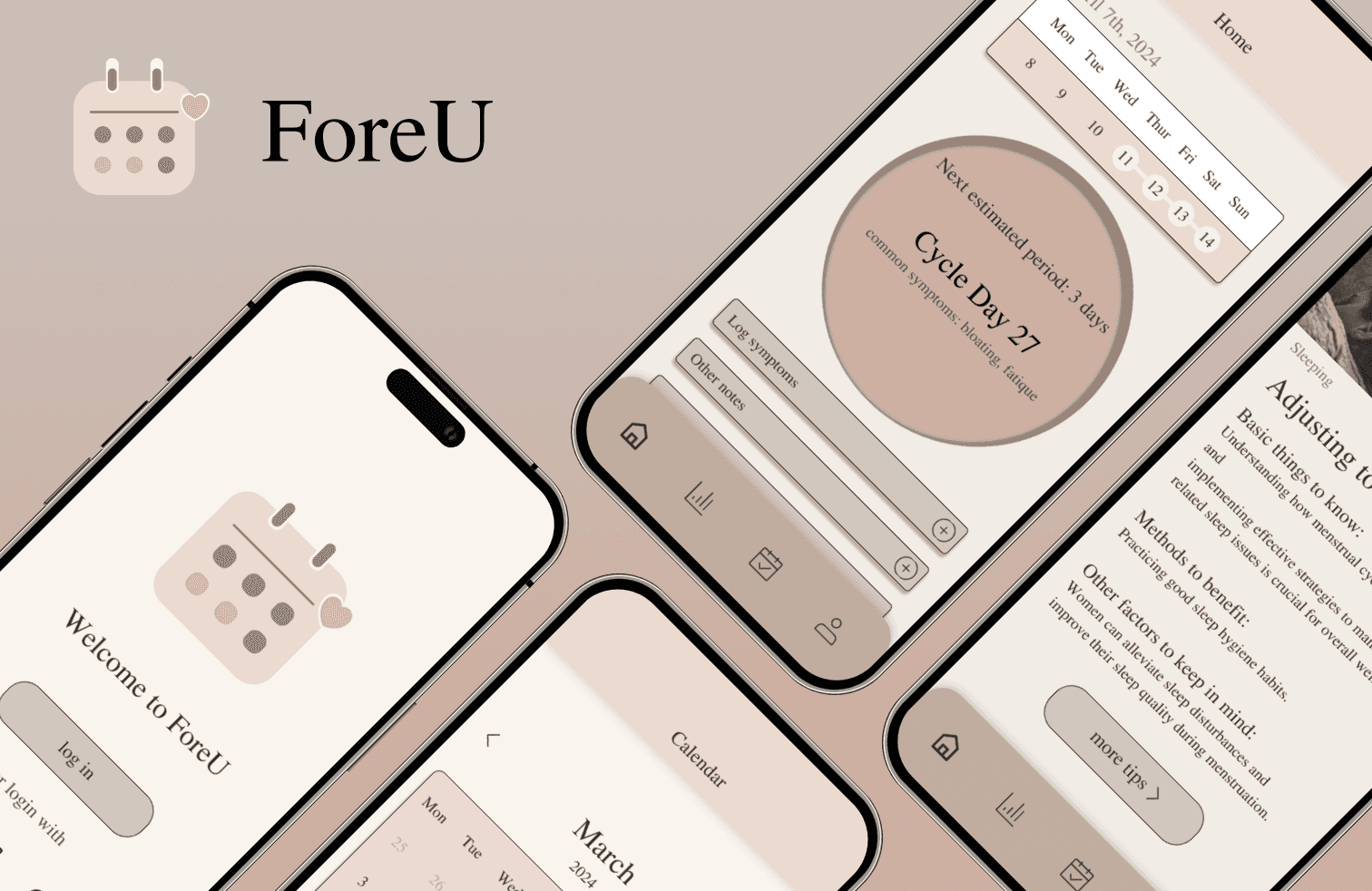
ForeU is a period tracking app designed as a UI case study for a habit tracking app. The project was driven by a clear user pain point: existing period tracking apps were overwhelmingly feature- heavy, leaving users frustrated by cognitive overload and unnecessary complexity.
Role
Product Designer
Team
3 Designers
PROJECT SUMMARY
Savr is a mobile app designed to reduce food waste by tracking items in a digital pantry and notifying users of upcoming expiration dates. The project was pitched at the CSUF Design-a-thon, where the team won 1st place overall.
Objective
Sympathize
Problem
Ideation
Prototype
Test
Final Product
Reflection
Key Insights and Objectives
Existing apps had lost sight of their core purpose. Both Flo and Clue had expanded into social and wellness platforms, leaving users who just wanted basic period tracking feeling overwhelmed and underserved.Cognitive overload was the primary complaint. Users consistently flagged too many options, too much information on a single screen, and too many steps to complete simple tasks — pointing directly to the need for a stripped-back, focused design.Simplicity was a competitive advantage. One user had abandoned Flo entirely in favor of the iPhone's built-in calendar app, citing efficiency. This was a clear signal that there was real demand for a purpose-built app that prioritized ease over feature breadth.The target user had specific, practical needs. Designing for users with irregular cycles who were often forgetful meant that reminders, clear cycle countdowns, and symptom prediction needed to be surfaced prominently and without friction.
SYMPATHIZE
Understand habits
To better understand how college students tracked their habits and interacted with existing period tracking apps, our team conducted both surveys and user interviews.
OUR GOAL: we wanted to focus and keep our audience specific - to gather enough information from college students to design an app that would help them track their habits in a clearer and more concise way. Alongside primary research, the team conducted a competitive analysis and SWOT evaluation of the two leading platforms — Flo and Clue — examining their features, user ratings, and the most common praise and criticism from real users. This combination of firsthand interviews and competitive data gave the team a well-rounded view of both the user's experience and the gaps in the current market.
Flo vs Clue
FEATURE
Period Prediction
Calendar View
Symptom Logging
Pregnancy Mode
Birth Control Tracking
Community / Forums
Free Tier
Premium Price / Year
✓
✓
✓
✓
◐
✓
✓
$50
✓
✓
✓
✓
◐
ⅹ
✓
$40
✓
✓
✓
✓
✓
✓
✓
$40
✓
✓
◐
ⅹ
✓
ⅹ
✓
free
FLO
CLUE
GLOW
DRIP
✓ = completely supported
◐ = partially supported
ⅹ = not supported
Analytical: "All four apps cover the core features — but Drip stands out as the only fully free option, while Flo charges the most with the least differentiation."
Insight-led: "The competitive landscape is saturated with similar feature sets. The real gap isn't what these apps offer — it's how overwhelming they are to use."
Design-direction focused: "With core features commoditized across competitors, ForeU's opportunity wasn't to add more — it was to do less, better."
User-need focused: "Every app tracks periods. Not every app makes it feel simple. That's the gap ForeU was designed to fill."
Understand habits
To better understand how college students tracked their habits and interacted with existing period tracking apps, our team conducted both surveys and user interviews.
OUR GOAL: we wanted to focus and keep our audience specific - to gather enough information from college students to design an app that would help them track their habits in a clearer and more concise way. Alongside primary research, the team conducted a competitive analysis and SWOT evaluation of the two leading platforms — Flo and Clue — examining their features, user ratings, and the most common praise and criticism from real users. This combination of firsthand interviews and competitive data gave the team a well-rounded view of both the user's experience and the gaps in the current market.
User persona
INSERT PHOTO
The persona developed for ForeU represented a college student dealing with irregular period cycles who was often forgetful and needed a reliable, low-effort way to stay on top of their tracking. This user didn't want a wellness platform or a social app — they wanted something that worked quickly, reminded them when needed, and didn't require them to navigate through layers of features to find what they were looking for.
Affinity Mapping
INSERT PHOTO
After collecting and synthesizing the research, the team moved into affinity mapping and mind mapping to organize their findings into actionable design directions. Ideas were grouped into three main categories: functionality, reminders, and UI design. Within each category, the team evaluated what to change, add, or keep — using the research to make deliberate decisions rather than guessing. This process helped the team align on a shared vision for the product and ensured that every feature included in ForeU had a clear research-backed reason for being there.
THE PROBLEM
"How might we develop a menstruation tracking app that is minimalistic and visually appealing, allowing users to track and predict their symptoms?"
This question kept the team grounded throughout the design process. Every decision — from the color palette to the number of screens to the depth of the feature set — was filtered through this lens. The answer the team arrived at was rooted in restraint: a neutral color scheme, a focused set of core features, a clear cycle countdown, and a symptom tracking flow that was fast and frictionless. ForeU wasn't trying to be everything — it was trying to be exactly what users had been asking for and not finding anywhere else.
IDEATION
Sketching
INSERT PHOTO
With the research insights and ideation categories defined, the team moved into low-fidelity sketching to begin visualizing the structure and layout of the app. Features discussed during ideation were sketched out and arranged into a general layout, giving the team a tangible starting point before moving into digital wireframes. This stage was fast and exploratory, focused on testing layout ideas and establishing a basic flow before committing to any visual direction.
Feature Matrix
INSERT PHOTO
The competitive analysis played a central role in shaping the feature decisions for ForeU. By identifying what Flo and Clue were doing well and where they were falling short, the team was able to make intentional choices about what to include and — just as importantly — what to leave out. Core features prioritized for ForeU included period tracking, cycle countdown, symptom logging, and reminders. Features that contributed to cognitive overload in competitor apps, such as extensive social sharing, water intake tracking, and article feeds, were deliberately excluded to keep the experience clean and focused.
PROTOTYPE
User Flow
INSERT PHOTO
After completing the low-fidelity sketches and ideation, the team developed a storyboard and user flow to map out how a user would move through the app and interact with its key features. The flow was built around the core actions a user would need to take — onboarding, logging a period, tracking symptoms, viewing their cycle countdown, and setting up reminders — and was designed to minimize the number of steps required to complete each task. The user flow was finalized in Figma and served as the structural blueprint for the wireframes and prototype that followed.
Mid-Fidelity
INSERT PHOTO
Branding
INSERT PHOTO
The visual design for ForeU was built around a neutral color scheme chosen to feel calm, approachable, and gender-inclusive — deliberately avoiding the bright pinks and reds commonly associated with period tracking apps. The palette supported the minimalist design philosophy, keeping the interface clean and easy to read without visual distraction. Typography was selected to balance clarity with approachability, using a defined hierarchy to guide users through the interface efficiently. Together, the color and type decisions reinforced the app's core promise: a simple, visually appealing experience that didn't overwhelm.
TEST
User Testing
INSERT PHOTO of changes
User testing was conducted with a small group of participants using the mid-fidelity wireframes. Testers were asked to navigate through the core flows — logging a period, tracking symptoms, and checking their cycle countdown — and share feedback on the clarity and ease of the experience. The minimalistic layout and straightforward navigation were well received, with users appreciating the reduction in steps compared to the competitor apps they were used to. Feedback gathered during this stage was used to make final adjustments to the layout and flow before the prototype was completed.
FINAL PROTOTYPE
INTRODUCING: ForeU
INSERT GIFS of Prototype
The final prototype for ForeU brought the team's vision to life in a polished, cohesive iOS app experience. The neutral color scheme, clean typography, and minimalist layout worked together to create an experience that felt immediately calm and easy to use. The core flows — onboarding, period logging, symptom tracking, cycle countdown, and reminders — were all refined to require as few steps as possible, directly addressing the friction points identified during research. The final design was a deliberate and considered response to everything users said was broken about existing period tracking apps, delivering a focused tool that did exactly what it promised and nothing more.
REFLECTION
Key Takeaways
INSERT PHOTOS
ForeU reinforced that simplicity is a design decision that requires just as much intentionality as complexity. Stripping a product back to its essentials means making hard choices about what to leave out — and the research made clear that those choices had real impact on how users felt about the experience. The competitive analysis was particularly valuable, not just for identifying what competitors were doing wrong, but for understanding why users were abandoning polished, well-resourced apps in favor of something as basic as a built-in calendar. That insight shaped everything. The project also strengthened the team's ability to translate UX research directly into UI decisions, ensuring that every visual and structural choice traced back to something a real user had expressed. Most broadly, ForeU was a reminder that designing for clarity and ease is one of the most meaningful things a designer can do — especially when the product touches something as personal as a user's health.
Next Steps
Looking ahead, the team identified two key areas to build upon in future iterations of ForeU. The first was animating the cycle countdown to make it more dynamic and engaging — transforming a functional element into something that felt alive and rewarding to interact with. The second was the introduction of an app mascot to bring personality and warmth to the experience, making the app feel more fun and approachable for users who engage with it on a regular basis. Beyond these immediate enhancements, future development would also explore expanding the reminder and notification system to be more personalized, refining the symptom prediction algorithm as more user data is collected over time, and conducting broader usability testing with a more diverse user group to validate the design decisions made during the initial sprint.